
Springfield Address Sources by Era
The backward trail behind a Springfield address changes as the records change. Modern parcel information can identify a current legal description and a recorded transfer. Older work moves into Recorder books, archival deed indexes, tax books, directory volumes, and census material. Use the source that matches the time period and the question. Ownership, household presence, building change, tax support, and family transition each have different record trails.
| Source | Years It Covers | Where Held | What It Shows |
|---|---|---|---|
| Assessor parcel record | Current public system | Greene County Assessor | Situs, PIN, owner and mailing fields, sale and property context |
| Recorder deed books | 1833 into the 1960s at Archives; current search separately | Recorder and Greene County Archives | Recorded parties, dates, instruments, and legal descriptions |
| Archives deed index | 1833–1877 | Greene County Archives | Historic deed-index lead, book/page route, and role abbreviations |
| Collector tax books | 1833–present | Greene County Archives and Collector | Year-by-year parcel and tax support |
| Assessor property sheets | Mainly 1950s–1970s | Greene County Archives | Property characteristics between older books and modern parcels |
| City and cross-reference directories | 1878–present holdings; cross-reference 1950–2006 | Springfield-Greene County Library | Dated household and address leads |
| Census microfilm | Missouri schedules 1830–1930 in the Library collection | Library Center | Household members, ages, birthplace, and occupation |
Greene County Archives' record-series list is the best starting point when the desired era predates a modern portal.
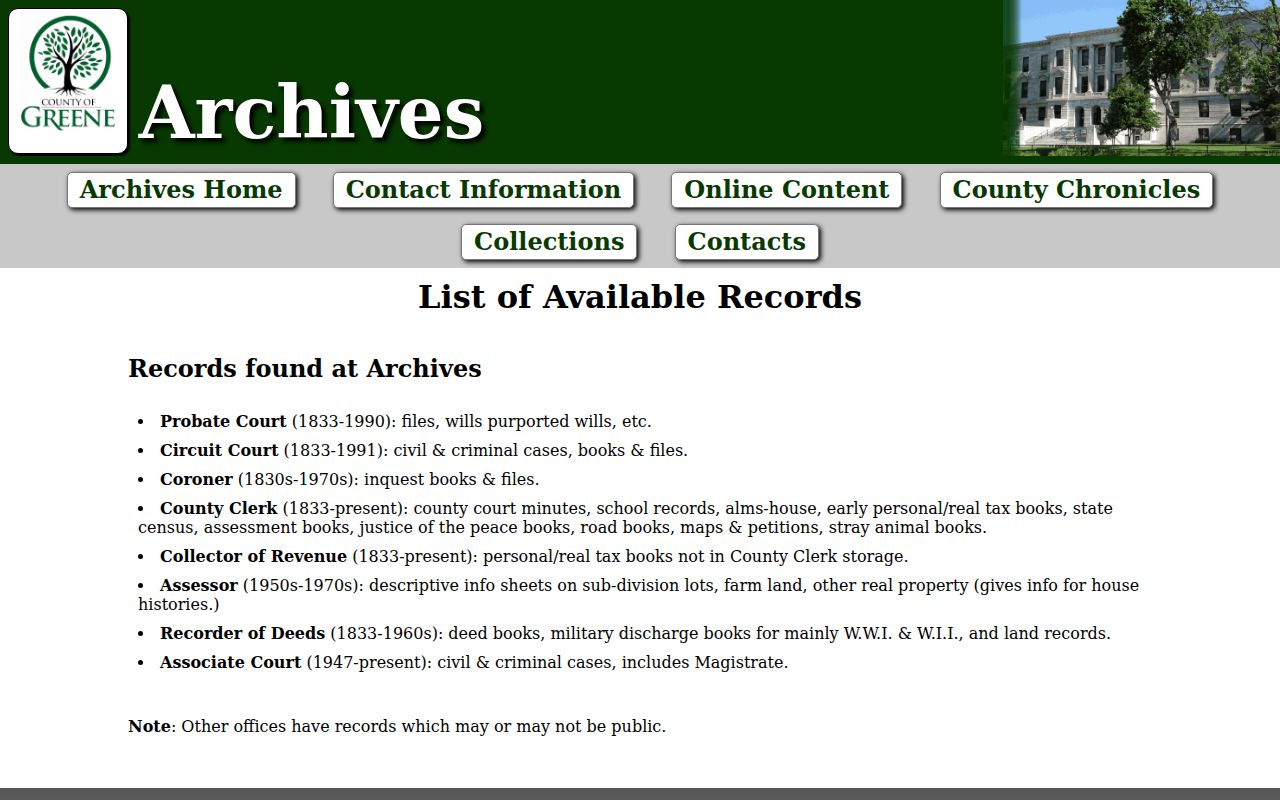
The listed date ranges help select an archival source before a name or address search begins.
Start Springfield Past Residents With a Parcel
For former residents, the present-day street form is a starting point, not the final key. Search the Greene County Assessor public portal for the situs and parcel ID, then preserve the legal-description context. The Recorder FAQ specifically tells address-only researchers to seek that legal description from the Assessor. It can bridge a changed street number, a subdivision, or a parcel split more reliably than a name or a postal label.
The Recorder's separate historical tax-lien search covers 2008 and prior, while 2009 to present belongs in Real Estate Search. Its visible routes are document number, name, and document type. Use this as a dated document layer, not as a replacement for the deed chain or a statement of who lived at a property.
The Recorder's historical tax-lien search is an additional document route when the date falls in its stated coverage.
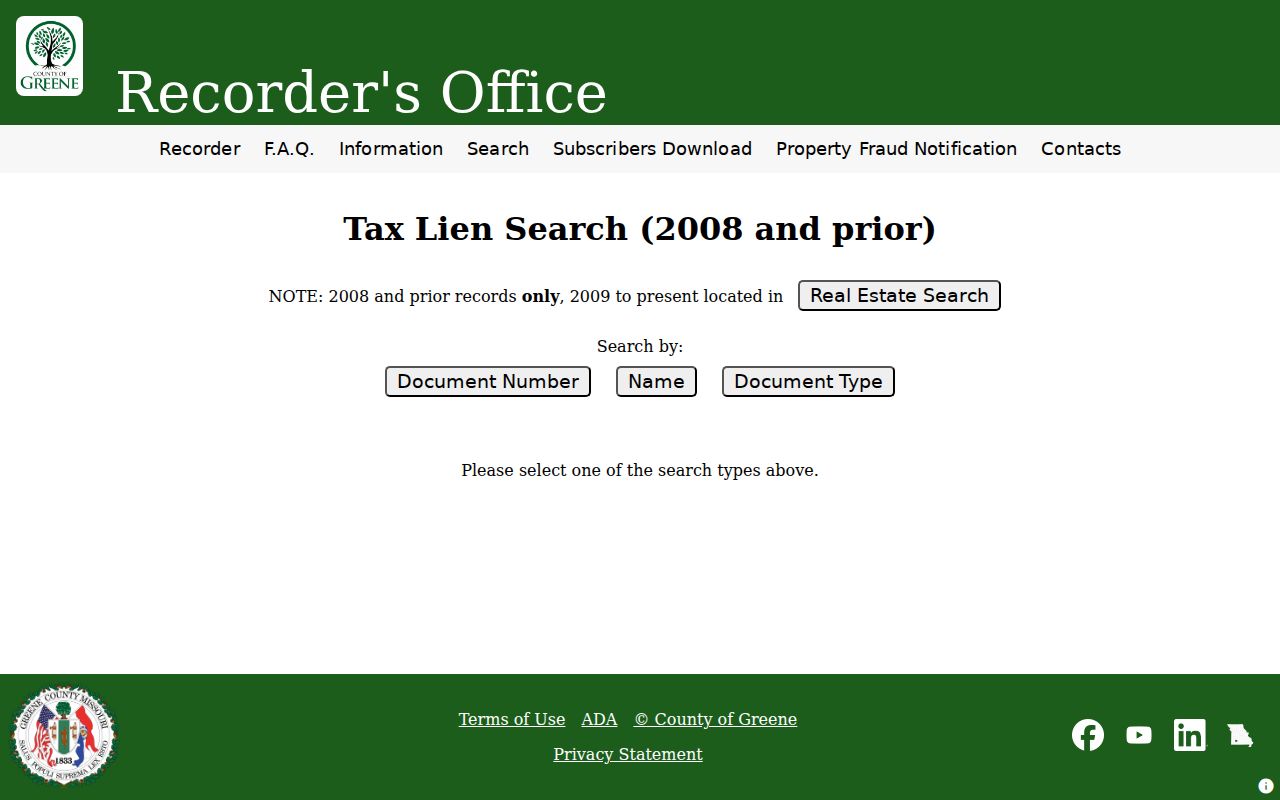
The separate search tabs reinforce the value of recording a document number, party name, and date range in a house-history log.
Follow the Greene County Deed Chain
A chain of title follows recorded transfers backward. Start from a current parcel's legal description and latest recorded deed. The buyer in that deed becomes the grantee, and the seller becomes the grantor. To move back one link, search the earlier seller as a grantee for the deed by which that person acquired the property. Record both the execution date and recording date, because they are not always the same event.
- Capture the current situs, PIN, and legal-description context from the Assessor.
- Search the Greene Recorder real-estate routes using the strongest key available, then note the latest recorded instrument.
- Save grantor, grantee, instrument type, execution and recording dates, book/page, document number, legal description, and cross-references.
- Search the prior seller as grantee and repeat the same documentation for the earlier transfer.
- When a current search does not reach the needed era, use the Archives deed index and original book/page, tax books, plats, probate, or the Recorder counter to test the gap.
- Grantor / grantee
- The grantor transfers an interest in a recorded document; the grantee receives it. Their roles are not interchangeable in a backward search.
- Chain of title
- A sequence of recorded transfers for the same legal property. It shows recorded conveyances, not every resident or every unrecorded agreement.
- Legal description
- The lot, tract, subdivision, or other formal property description used in recorded documents. It is more stable than a street number when addresses change.
- Criss-cross directory
- A directory arranged from address to name. It can supply a dated household lead after the property chain is established.
The Greene County Archives deed-record index describes the historical index and its verification cautions.
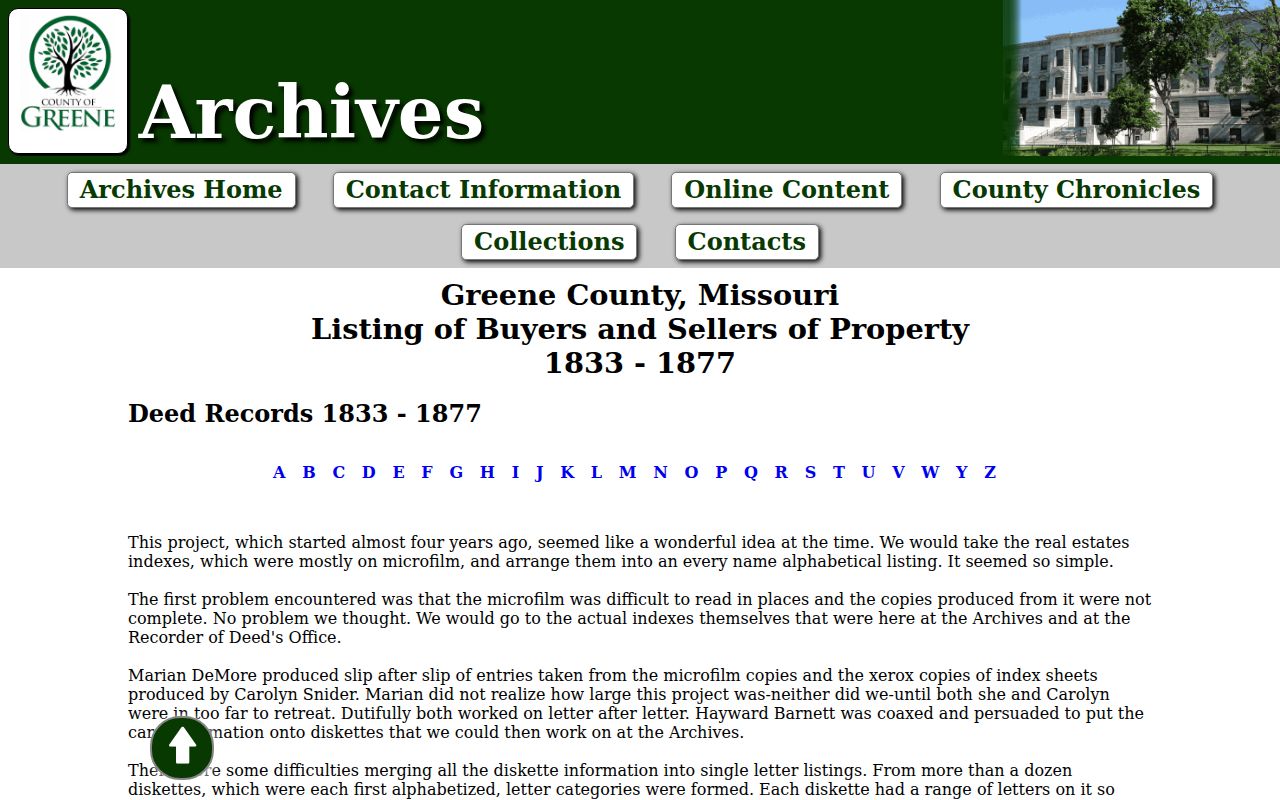
Use an index line as a lead to the original deed book or image, where the legal description and full record can be checked.
Greene Deed Clues Need Verification
Greene's 1833–1877 deed index was assembled from microfilm and original indexes. It contains more than deed material, including incorporations, wills, chattel mortgages, railroad items, and records involving enslaved people. That breadth makes it valuable for a former-resident trail, but it also means an index result must be read in its actual record context. The Archives warns about gaps, missing pages, duplicate or conflicting entries, single-side entries, and spelling variants.
The index also uses local abbreviations. “Gr” and “Gt” mark grantor and grantee, while names may be shortened as Wm, Jas, Jno, or Chas. Other notations include shrf or shff for sheriff, tr’stee for trustee, adm or admr for administrator, and Sprfld for Springfield. Do not expand an abbreviation into a different person or role without checking the original book. Note: An unresolved index gap is a valid result and should remain marked as such.
1947 Springfield Address Renumbering
Springfield's 1947 renumbering can break a straight address search. The Library's conversion examples change 415 Mitchell St to 415 E Olive St and 810 E McDaniel St to 1008 E McDaniel St. A past-resident search that crosses 1947 should retain both forms, the directory year, and a source note. Also check changes in direction, suffix, postal label, subdivision, annexation, and parcel boundaries before assuming an old and modern address describe the same place.
The Greene Recorder FAQ explains the address-to-legal-description handoff that can steady a search when historical street forms do not match.
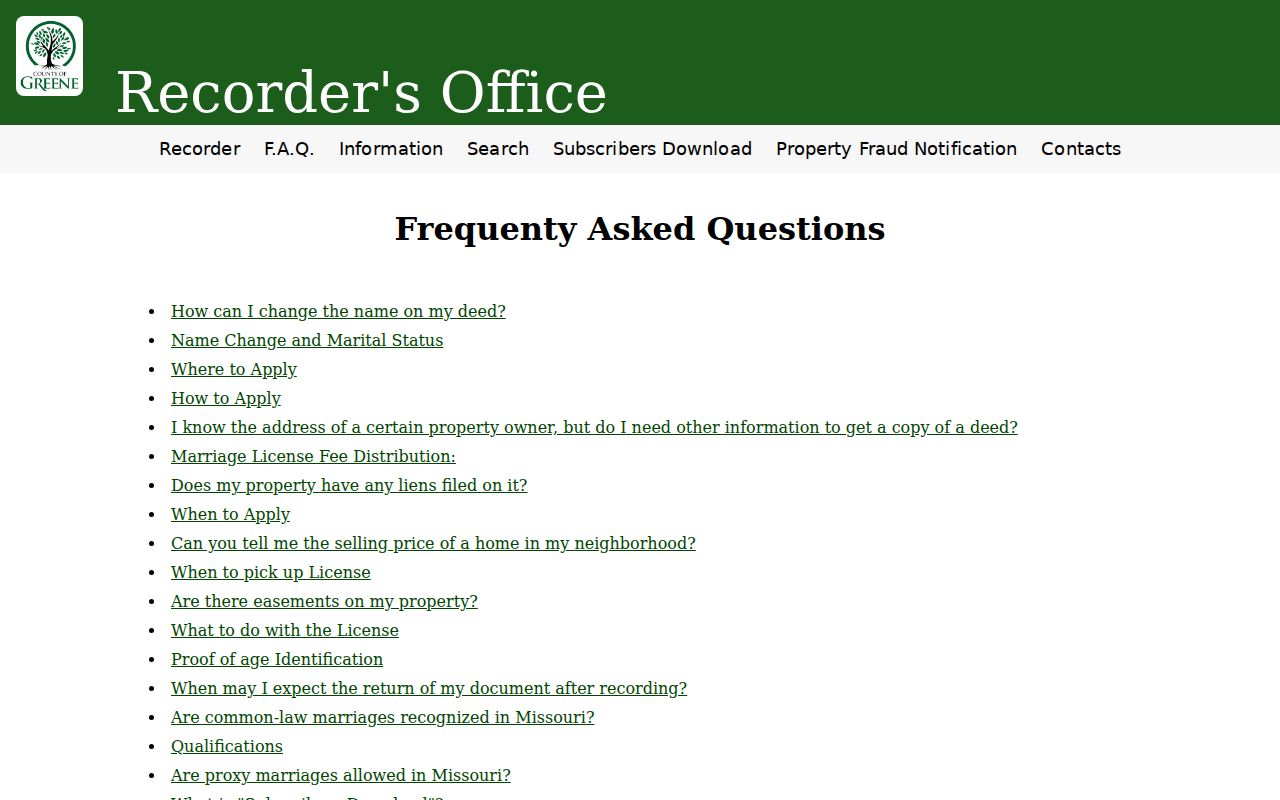
Use the Assessor and the Library's local-history staff to test an old and modern address rather than forcing a match from the number alone.
Pair Springfield Directories With Census
Recorded owners are only part of the past-resident story. The Library Center's cross-reference directories can move from address to name for 1950 through 1970 on microfilm and 1971 through 2006 in closed storage. City-directory holdings begin in 1878 and continue in changing formats. Pair a directory entry with census evidence rather than merging a common name on sight. The Library's Missouri census microfilm covers population schedules from 1830 through 1930 and can add household members, ages, birthplaces, and occupations.
- Search the relevant directory year by surname and, where available, by street or dwelling-number index.
- Write down the address exactly as printed, then test the pre- or post-1947 form if the year requires it.
- Compare the closest census schedule for household members, age, birthplace, and occupation.
- Use newspaper, Hall Index, cemetery, or deed evidence to resolve a name variant or household transition.
- Keep a person distinct until more than one dated source supports the match.
Greene County Archives family-history research supplies a local route to death-certificate and family-history context.
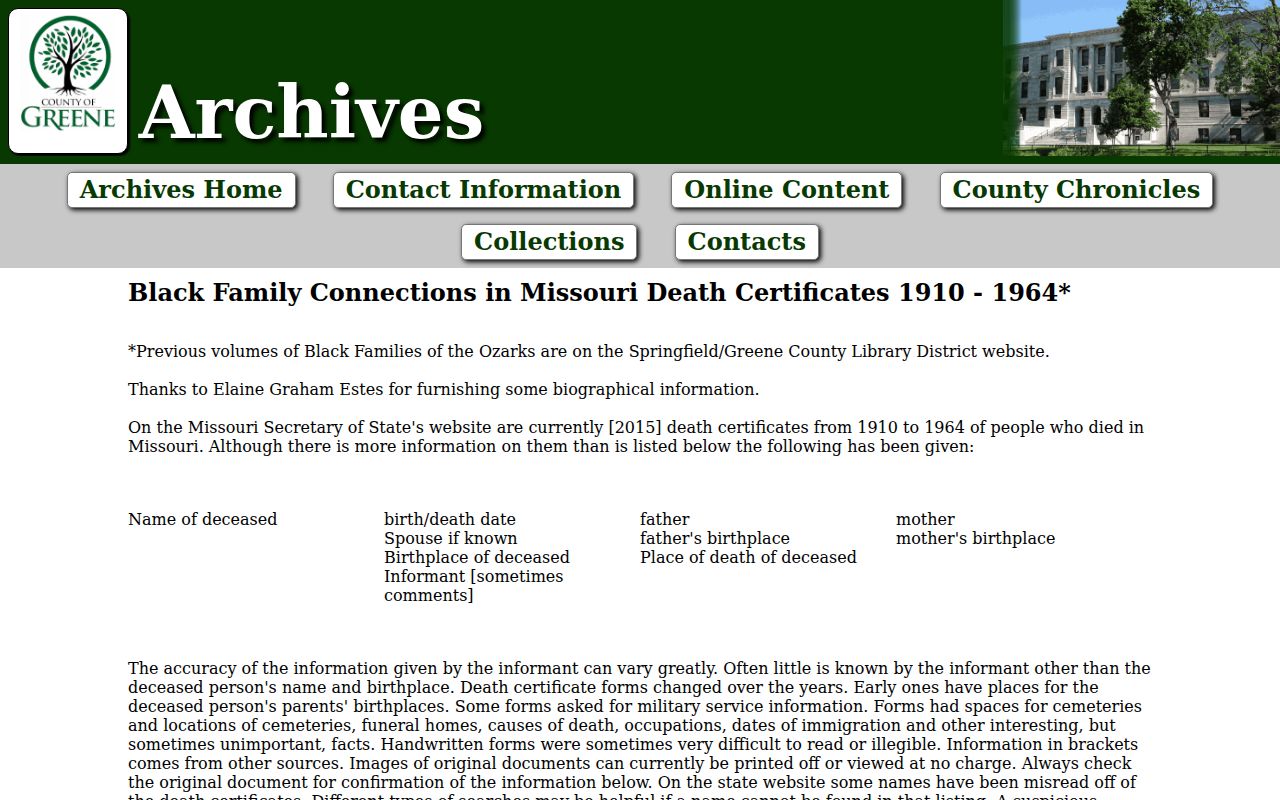
The archival family-history route can help confirm a dated transition after the address sources identify a likely household.
The library offers “Ask a Local Historian” support for closed-storage directory years and the address-conversion problem. The directory collection itself is detailed on the Springfield Directory Book page, while this address trail uses those volumes only as dated household evidence.
Springfield Address and Family Transitions
When a deed chain pauses, use property and probate context instead of guessing at a household change. Greene County Archives lists probate court records from 1833 to 1990, with paper files from 1833 to 1899 and no index for files before 1870. It also maintains a will book for 1836–1861 and an online file index. Probate can identify heirs or administrators, but it is not a full residency record. Collector tax books from 1833 to the present and Assessor descriptive property sheets from the 1950s–1970s can add year-by-year property continuity.
Springfield permits are another dated event layer. The city's reported fields include permit number, address, applicant, project name, issued date, use, and milestone. A permit can date construction or alteration activity, but the applicant is not automatically an owner or occupant. Keep that distinction beside every result.
The Greene County historic probate index provides the file-reference route for a transition that cannot be resolved through deeds alone.
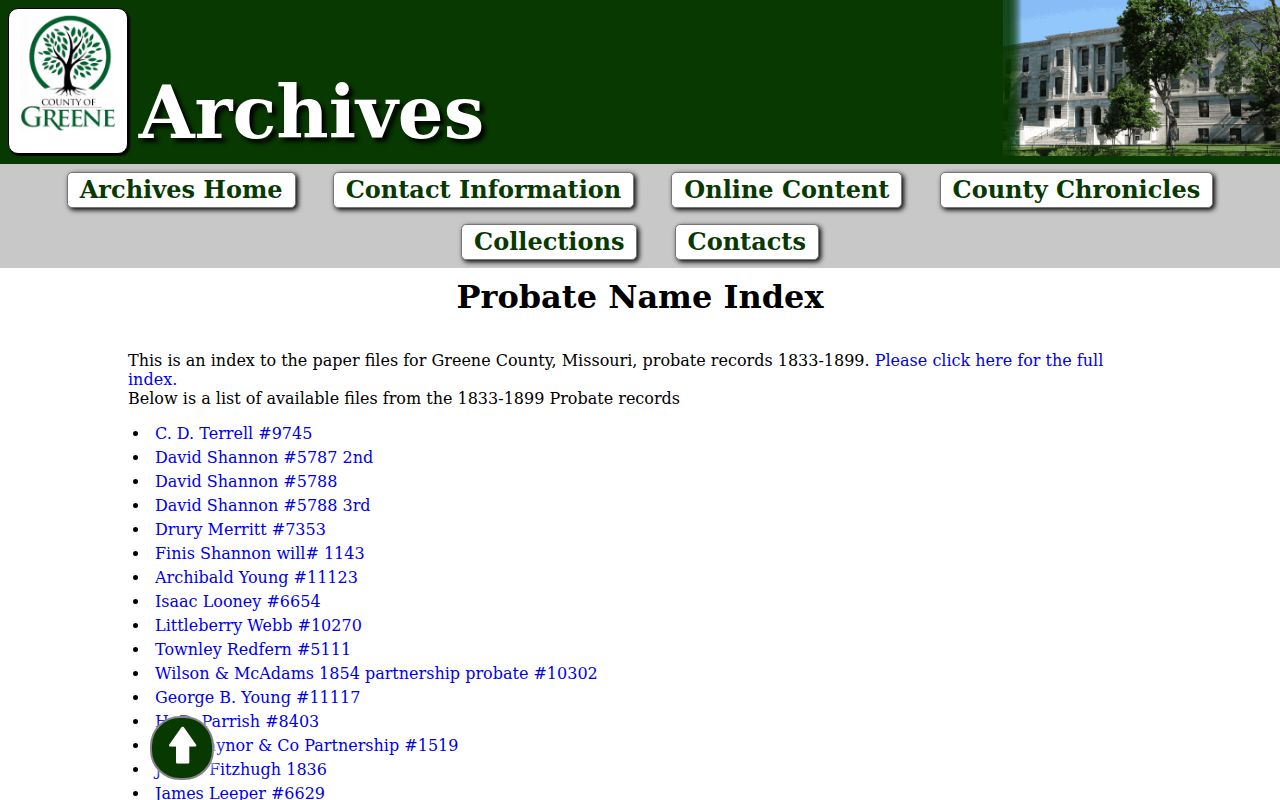
Probate, tax, and permit sources can narrow a date range, but the original record remains the check on any conclusion.
Boundaries on Springfield Past Resident Research
Previous-resident results are not a current directory. A directory is a dated publication, a deed is a recorded transfer, a census is a time-specific enumeration, and an obituary or archival index is a lead requiring source and identity checks. Court, vital, juvenile, sealed, expunged, protected, and Safe at Home information can be restricted. Missouri vital records also have direct-and-tangible-interest rules for certified copies.
Use the smallest necessary identifier and preserve only the research details needed to verify a historical or property question. When a record cannot connect an address to a person without speculation, stop at the documented gap. A focused request under the Missouri Sunshine Law, Chapter 610 RSMo, should name the holding office, record series, address or parcel key, date range, desired format, and maximum cost.
Lawful use. Use Springfield previous-resident records for family history, estate research, civic context, and property history. Never use an address trail to stalk, harass, monitor, or harm a living person.